
UGC New Equity Regulations 2026: Why Protests Have Spread Across India
The University Grants Commission's new equity regulations have become one of the most contentious higher-education policy issues in India this year. The rules were introduced with the stated objective of strengthening measures against discrimination in higher education, but they quickly attracted opposition from several organisations and groups that questioned parts of the framework.
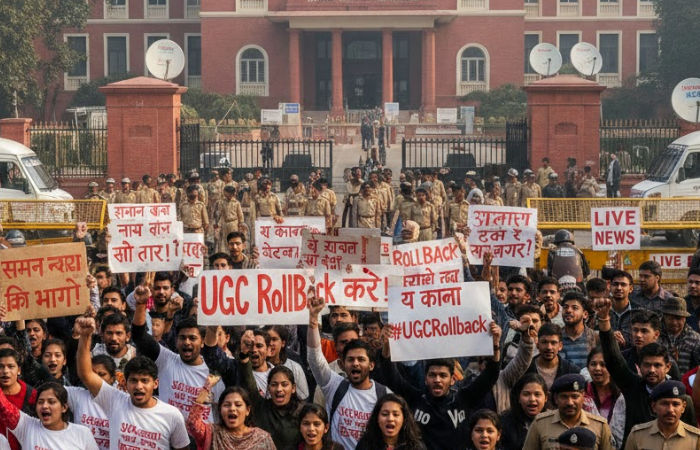
The controversy has moved beyond university campuses. Protests and public demonstrations have taken place in Delhi, Rajasthan, Uttar Pradesh and other parts of the country, while supporters of stronger campus protections have also organised campaigns in favour of the regulations.
What Are the New UGC Equity Regulations?
The University Grants Commission (Promotion of Equity in Higher Education Institutions) Regulations, 2026 were notified on January 13, 2026. The regulations were intended to apply across higher education institutions and establish a more detailed framework for preventing and addressing discrimination.
The framework sought to require higher education institutions to take measures against discrimination on grounds including caste, creed, religion, language, ethnicity, gender and disability. It also provided for institutional mechanisms intended to promote equity and address complaints.
The UGC's official regulations page lists the 2026 Equity Regulations as a new regulation notified on January 13, 2026.
Why Did the Regulations Become Controversial?
Opposition to the rules centred on the wording and structure of some provisions. Critics argued that certain definitions were too broad or unclear and could potentially be misused on university campuses. Some groups also objected to changes relating to the handling of complaints and representation within equity mechanisms.
Supporters of the regulations, however, have argued that stronger institutional safeguards are necessary to protect students who face discrimination and to ensure that complaints can be addressed through formal mechanisms.
What Did the Supreme Court Say?
The Supreme Court intervened soon after the regulations were notified. On January 29, the Court kept the 2026 regulations in abeyance and directed that the earlier 2012 regulations would continue to operate until further orders.
The Court raised concerns about the wording of some provisions, including whether parts of the framework were sufficiently clear and whether certain provisions could have unintended consequences. It also questioned aspects of the definition of caste-based discrimination and the treatment of ragging within the framework.
The Court's intervention meant that the 2026 regulations did not simply proceed as a new nationwide framework while the legal challenges were being considered.
How Did the Protest Movement Begin?
Opposition demonstrations began soon after the regulations were notified. In Delhi, students and other protesters gathered outside the UGC headquarters in January, with demonstrators demanding that the regulations be withdrawn or reconsidered.
The movement later spread to other cities. Protesters included student groups as well as organisations representing particular social and community interests. Their arguments were not identical, but many opponents focused on what they described as ambiguity, possible misuse and concerns about the impact of the regulations on different categories of students.
Protests Continued Months Later
The dispute did not end with the Supreme Court's January intervention. Demonstrations continued during 2026, particularly as different groups continued to debate the regulations and the broader question of caste, equity and representation in higher education.
In Jaipur, a protest against the regulations escalated into a confrontation with police in August. Reports said barricades were breached and police used force and water cannons to control the situation. The protest was part of a longer agitation demanding changes to or withdrawal of the regulations.
In Lucknow, more than 300 people were reported to have participated in a protest on August 23 against the UGC rules and reservation policies. In Delhi, police said no permission had been granted for a planned protest at Shah Auditorium against the UGC regulations and the reservation system.
There Are Also Supporters of the Regulations
The public debate has not been limited to opposition. Student groups and organisations representing historically disadvantaged communities have argued that strong anti-discrimination mechanisms are important in higher education.
Earlier in the year, students at Banaras Hindu University and other locations participated in campaigns supporting implementation of the equity regulations. Some supporters argued that weakening or withdrawing the framework could reduce protections available to students facing discrimination.
Why Is the Issue Important for Students?
Universities are spaces where students from different social, regional, linguistic and economic backgrounds study together. The way institutions respond to discrimination can affect students' academic experience, access to support and confidence in the university administration.
At the same time, complaint mechanisms need to be transparent and fair. Students and faculty members across categories have an interest in knowing how allegations will be assessed, what evidence will be considered, and what protections exist against both discrimination and wrongful complaints.
Key Dates
What Happens Next?
The immediate question is whether the Centre and UGC will modify the 2026 framework before bringing it back to the legal and regulatory process. The Supreme Court proceedings will also remain important because the Court has already raised questions about the wording and possible consequences of the regulations.
For students, the eventual outcome could determine how universities structure equity committees, complaint mechanisms and institutional responses to allegations of discrimination. For policymakers, the controversy highlights the challenge of designing rules that are strong enough to address genuine discrimination while remaining clear, fair and resistant to misuse.
Conclusion
The UGC Equity Regulations controversy has developed into a much larger debate about equality, caste, reservation, student rights and institutional accountability in Indian higher education.
The regulations were introduced with the stated goal of promoting equity and preventing discrimination, but parts of the framework generated strong opposition and ultimately came under judicial scrutiny. With the Centre now saying that the regulations are under reconsideration, the next version of the policy could become an important test of how India balances anti-discrimination protections with procedural safeguards.
Comments
Post a Comment